


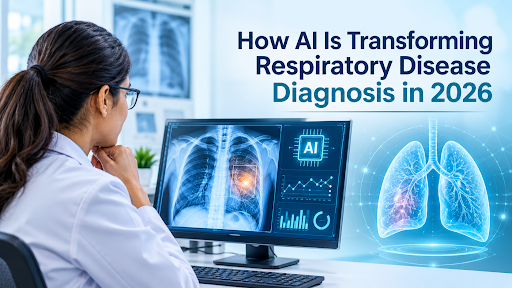
Following a prolonged cough, it is common to have imaging of the chest. There is a great deal of information visible about the lungs and other structures.
All of this will usually be interpreted based on the knowledge gained by the doctor’s training and subsequent experience. Increasingly, AI may be able to offer some further information.
There are a number of situations in which AI may play a role, most notably with images, lung functions and other features which may be useful to flag up.
Of course, all of these may only be helpful in aiding the diagnosis.
The Real Change Is in How Medical Information Gets Analysed
Respiratory diseases rarely announce themselves through one unmistakable symptom.
A persistent cough might indicate asthma, infection or another respiratory condition. Breathlessness could involve the lungs, heart or several contributing factors.
Doctors must connect symptoms with examination findings and investigation results.
AI systems are being developed to recognise patterns across complex medical information, potentially helping clinicians identify abnormalities or prioritise further assessment.
For a respiratory consultant, these technologies may provide additional information when interpreting investigations, although their clinical usefulness depends on the particular tool and its validation.
1. Chest Imaging Is Becoming More Data-Driven
There has been extensive work to date regarding interpretation of various images.
Programmes are available, for example, which will ‘flag’ features on X-ray or CT scan, to draw the attention of the radiologist or other doctor.
This could be areas of concern to look for lung cancer, areas suggestive of pneumonia, features on CT scan relevant to interstitial disease, or to detect and assess areas suspicious of malignancy, to give a few examples.
Obviously none of these would be diagnostic in themselves; there may well be a pathological process, a normal variant, or other reason, for example artefact, for the appearance. It would be for the relevant doctor to assess these in the context of each individual.
2. Lung Function Testing May Reveal More Than Basic Measurements
Lung functions, in particular spirometry, have an important role to play in many situations, most obviously asthma and COPD.
Various groups have tried to develop programmes to extract other useful information from the range of values obtained.
These may be useful to identify a range of patterns of impairment, or in situations where differentiation may be difficult.
Provided, of course, the tests have been satisfactorily carried out, to an acceptable standard. There will always be tests of varying degrees of inadequacy which no program will be able to overcome.
Obviously the more informative and accurate the underlying tests, the more beneficial any such programme may be.
3. AI Could Help Identify Patients Who Need Earlier Attention
Patients may have a variety of features over time, such as number and severity of exacerbations, level of disability, changes on serial investigations, all of which may suggest the presence and progression of a particular disease process.
It would be possible for programmes to pick up various combinations of such features, to alert the doctor to patients deserving more detailed evaluation.
Thus flag up deteriorating features; draw attention to various degrees of abnormality to aid triage; highlight those who may need more detailed investigation; and generally assist in sifting through large quantities of data.
All subject to adequate information being available and reliable, programmes being suitably validated, and so on. Nor should it be assumed that all or any of these would lead to an earlier diagnosis.
Where AI Still Falls Short
AI systems can produce convincing outputs while overlooking important clinical details.
A model trained on one patient population may perform differently when used elsewhere. Incomplete records, imaging variations and uncommon conditions can also affect reliability.
There are further considerations involving patient privacy, algorithmic bias and accountability.
Before using AI in clinical practice, healthcare providers must consider whether a tool is appropriately validated, regulated where required and suitable for its intended purpose.
A respiratory consultant must still evaluate the patient’s symptoms, examine relevant findings and decide whether the technology’s output makes clinical sense.
An algorithm may recognise a pattern. A clinician must understand the person behind it.
Does AI Mean Fewer Appointments or Tests?
Not necessarily.
Although AI may improve efficiency in selected settings, it does not eliminate the need for medical assessment.
Someone experiencing unexplained breathlessness may still require spirometry, chest imaging or other investigations.
Similarly, a suspicious imaging finding may require further evaluation before its significance becomes clear.
The appropriate pathway depends on symptoms, medical history and clinical findings rather than the availability of AI technology.
For patients, the most meaningful development is the possibility of better-supported decisions, not automated diagnoses.
Chest & Sleep Doctor: Specialist Judgement Remains Essential
Technology is changing respiratory medicine, but patients still need clear explanations, careful assessment and appropriate clinical decisions.
At Chest & Sleep Doctor, Dr Anand Singh provides specialist assessment for asthma, COPD, chronic cough, bronchiectasis and other respiratory conditions.
His experience in respiratory and sleep medicine supports a clinically grounded approach to investigating persistent breathing concerns.
As an experienced respiratory consultant, Dr Singh evaluates symptoms, medical history and relevant investigations to help establish appropriate diagnostic and management pathways.
We recognise that advances in medical technology are valuable only when they contribute to meaningful patient care.
Book a consultation with Dr Anand Singh at Chest & Sleep Doctor if persistent coughing, breathlessness or other respiratory symptoms require specialist assessment.
Frequently Asked Questions
1. Can AI diagnose lung disease accurately?
Some validated AI tools can support the detection of particular abnormalities, but diagnosis requires appropriate clinical interpretation.
2. Is AI used to detect lung cancer?
AI-assisted imaging tools are being developed and used in selected settings to support lung nodule detection and assessment.
3. Can AI identify asthma from breathing tests?
Research suggests AI may help interpret lung function patterns, but asthma diagnosis still requires established clinical assessment.
4. Will AI replace respiratory doctors?
AI may support selected diagnostic tasks, but it cannot replace the full clinical judgement and responsibilities of specialist physicians.
5. Should I wait for AI-based testing before seeing a specialist?
No. Persistent or worsening respiratory symptoms warrant timely assessment. A respiratory consultant can recommend appropriate investigations based on current clinical evidence.