

What is Bronchoscopy?
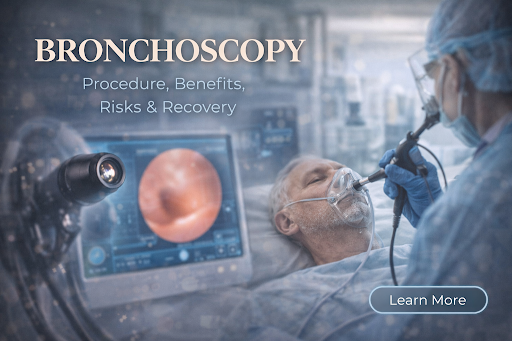
Bronchoscopy is a minimally invasive medical procedure that allows doctors to examine the inside of your lungs and airways using a thin, flexible tube fitted with a small camera, known as a bronchoscope.
It is widely used to:
- Diagnose lung conditions
- Investigate persistent respiratory symptoms
- Collect tissue or fluid samples
- Guide personalised treatment decisions
Bronchoscopy is considered a safe and effective diagnostic tool and plays a key role in identifying conditions that may not be clearly visible on imaging tests alone.
Types of Bronchoscopies
Flexible Bronchoscopy:
Flexible bronchoscopy is the most commonly performed type. It allows doctors to gently navigate the smaller airways and reach areas deeper within the lungs. The procedure is usually carried out using a local anaesthetic and mild sedation to keep you comfortable, and it is considered very safe.
Rigid Bronchoscopy:
Rigid bronchoscopy uses a straight metal tube and is performed under general anaesthesia. It is typically used in specific situations, such as removing large foreign objects, controlling significant bleeding, or treating blockages in the larger airways.
Diagnostic Pathway:
These procedures often form part of a wider diagnostic pathway:
symptoms → chest X-ray or other tests → bronchoscopy → sample analysis → treatment planning
Related procedures
During a bronchoscopy, your doctor may also carry out additional procedures, including:
- Bronchoalveolar lavage (BAL): A saline solution is gently washed into part of the lung and then collected to analyse cells and identify infection or inflammation
- Trans bronchial biopsies: Small samples of lung tissue are taken through the bronchoscope for further testing
- Bronchial brushings: A tiny brush is used to collect cells from the lining of the airways
Benefits of Bronchoscopy
Bronchoscopy is a valuable tool for diagnosing a wide range of lung conditions, including lung cancer, chest infections, persistent cough, coughing up blood, and other lung problems that may not be fully explained by scans alone. One of its main advantages is that it allows doctors to see directly inside the airways in real time, often leading to earlier and more accurate diagnosis.
In addition to diagnosis, bronchoscopy can also be used as a treatment. During the same procedure, your doctor may be able to remove blockages, clear mucus plugs, retrieve inhaled objects, or help control bleeding. Because bronchoscopy is minimally invasive, recovery is usually quicker, and the risks are lower than those of more invasive surgical procedures. It is particularly useful when symptoms persist despite standard treatment or when imaging results need further investigation.
Before the procedure
Initial consultation
Before your bronchoscopy, your healthcare team will review your medical history and current medications and explain clearly why the procedure has been recommended. This is your opportunity to ask questions and discuss any concerns. You’ll be asked to sign a consent form that outlines the benefits and potential risks, ensuring you feel informed and comfortable before proceeding.
Preparation
In the hours before the procedure, you’ll be given clear instructions to help keep you safe. This usually includes fasting for six to eight hours beforehand, although clear fluids are often allowed up to two hours before the bronchoscopy. Your doctor may advise you to temporarily stop or adjust certain medications, such as blood thinners or diabetes treatments.
Because sedation is commonly used, you’ll need to arrange for someone to take you home and stay with you for the next 24 hours. You may also be asked to remove jewellery, avoid alcohol for 24 hours beforehand, and follow any additional preparation guidance provided by your healthcare team.
During the procedure
When you arrive at the endoscopy unit, you’ll change into a hospital gown, and the team will check your vital signs, including blood pressure, heart rate, and oxygen levels. The bronchoscopy is performed in a specialised room, and you’ll be positioned comfortably on your back or side.
A local anaesthetic is applied to your nose and throat to reduce discomfort and suppress the gag reflex. Sedation is then given through a small cannula, helping you feel relaxed and drowsy while still able to respond if needed. As the bronchoscope is gently passed through your nose or mouth and into your lungs, you may notice mild pressure or an urge to cough, which is completely normal.
Once the bronchoscope is in place, the doctor examines your airways using the camera and may take samples or perform additional procedures, such as bronchial brushings or bronchoalveolar lavage, if required. Most people find the procedure comfortable and may remember little of it afterwards.
After the procedure
After the bronchoscopy, you’ll be taken to a recovery area where nurses will monitor your oxygen levels, blood pressure, and overall well-being while the sedation wears off. Numbness in the throat usually lasts one to two hours, and you’ll be advised not to eat or drink until sensation returns. Once it does, you can start with clear fluids, then gradually move on to soft foods. Hot drinks should be avoided initially to reduce the risk of burns.
Most people can go home after a few hours, but you’ll need someone to accompany you and stay with you for the rest of the day. Because sedation can affect judgment and coordination, you should not drive, operate machinery, or make important decisions for 24 hours. It’s normal to experience a sore throat, hoarseness, or a mild cough for up to 24-48 hours.
Before you leave, your healthcare team will arrange any follow-up appointments and provide contact details in case you have concerns. The doctor can often discuss initial findings straight away, although results from tissue samples usually take one to two weeks.
FAQs
Is bronchoscopy painful, and will I be awake during the procedure?
Most patients receive local anaesthesia and mild sedation, making the procedure comfortable and minimally painful. You’ll be drowsy but responsive throughout.
How long does it take to get bronchoscopy results?
Visual findings are available immediately, but tissue biopsy results typically take 1-2 weeks for pathology analysis.
What are the serious risks of bronchoscopy?
Major complications are rare (well under 1%), including bleeding, infection, or a collapsed lung, and your medical team will monitor you closely for these.
Can I eat normally after a bronchoscopy?
You must wait until the numbness in your throat subsides (usually 1-2 hours) before eating or drinking to prevent choking or food going down the wrong way.
What should I do if I experience chest pain or breathing problems after the procedure?
Contact your healthcare team immediately if you develop severe chest pain, difficulty breathing, or cough up significant amounts of blood – these could indicate rare complications requiring prompt attention.
Is bronchoscopy appropriate for all lung problems?
While bronchoscopy is excellent for many lung conditions, some problems deep in the lung tissue may require other tests, such as a CT-guided biopsy or advanced imaging. Your hospital doctor will determine the best approach for your specific situation.
Final Thoughts
Bronchoscopy is a highly effective, minimally invasive procedure that plays a crucial role in diagnosing and managing lung conditions. With its ability to provide real-time insights and enable targeted interventions, it helps ensure faster diagnosis and more personalised treatment.
When performed by experienced specialists, bronchoscopy is safe, well-tolerated, and an essential part of modern respiratory care.